

This will be my last newsletter for 2025. I have not been writing as much as I would have liked, mainly driven by a big focus on bringing Agentic CX to life in many of our projects.
While busy with the above work given the constant stream of press and social media associated with AI and how it will impact the business world, it sometimes is challenging to cut through the hype.
Recently we have seen lots of speculation of an AI bubble. This is evidenced in CoreWeave’s and Oracle’s share price both of which have dropped significantly recently and there have been numerous questions how OpenAI sustains a valuation of $500B with a $14B revenue and loosing significantly more money than they make (reportingly losses are $9B).
There are mixed reports on Microsoft’s success with some sources saying that they have lowered their AI Sales targets.
Then there is a report from MIT : https://mlq.ai/media/quarterly_decks/v0.1_State_of_AI_in_Business_2025_Report.pdf that indicates that 95% of organisations are getting zero return from AI.
With all this doom and gloom, does this mean that AI is worthless? No – in my opinion, are a likely headed to the through of disillusionment and then the real work will begin:
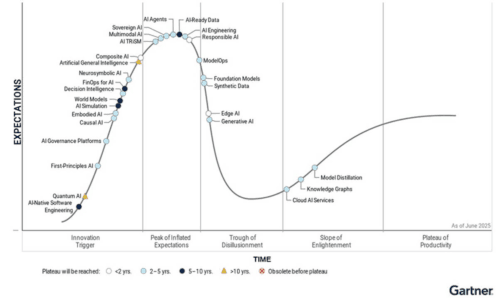
Gartner Hype Cycle for AI
The above observations are some contexts but not the substance of this article. What I would like to focus on is what it takes to be able to take advantage of AI Agents to improve customer experience and some discussion to show it is not as simple as it seems (although naturally not impossible)
The Power of LLMs to Emulate Personality
Despite the criticisms above, the one aspect of LLMs that is unsurpassed is the ability of LLMs to emulate personality. The key point is that the LLM needs to know the personality it is emulating. Below is a summary view of research from Nature.com that compares a reference database to various LLMs responses for different profiles of personality and the results are somewhere between mind blowing and scary!
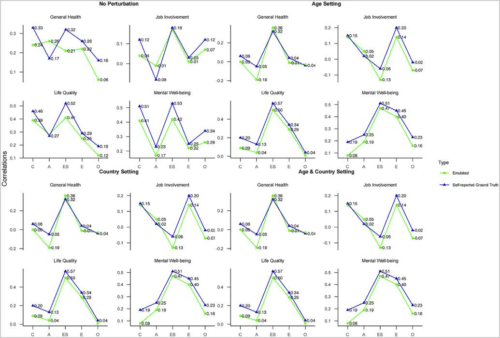
Nature.Com LLM Personality Emulation by LLMs
The Importance of Context
As we all know, context is the key difference in the success and failure of connections between people. The most basic of sales training teaches you that when meeting a new sales prospect, you should be identifying aspects of shared context and engaging on that subject. The most basic example is discussion the weather and that evolves to shared sports teams and then to other areas like a shared school or university, shared employers or shared experiences. If there is a shared context, humans can relate to each other.
The same is true for interacting with brands. When you deal with a high-end brand (personal banking, exotic sport cars, 5 star hotels), you expect that the service provider will know your context and respond accordingly. You expect that they have taken the effort to get to know you and to understand and ideally anticipate your needs.
The great digital brands do the same – Amazon knows your shopping behaviour and makes recommendations as does Spotify and Apple Music. Neflix has incredible capabilities in this regard, and all these brands have benefitted significantly from their recommendation and personalisation needs.
To be able to offer the best service for a specific individual, you need more than AI (or specifically, you need more than great LLM models). You need context of the customer to ensure their circumstances are understood and then utilised to offer better service.
Context Engineering
Context Engineering is the next “evolution” of prompt engineering. The most established context engineering approaches are typically associated with development of software. The challenge with developing large software systems is that the context window for LLMs (the amount of data a LLM can receive) is limited and thus a lot of work is required to get the key relevant elements into the context window.
There are some well-established techniques that are used to manage context due to context window constraints:
- Compaction – Compaction is the practice of taking a conversation nearing the context window limit, summarizing its contents, and reinitiating a new context window with the summary
- Structured Note Taking – Structured note-taking, or agentic memory, is a technique where the agent regularly writes notes persisted to memory outside of the context window. These notes get pulled back into the context window at later times.
- Sub-Agent Architectures – Sub-agent architectures provide another way around context limitations. Rather than one agent attempting to maintain state across an entire project, specialized sub-agents can handle focused tasks with clean context windows. The main agent coordinates with a high-level plan while subagents perform deep technical work or use tools to find relevant information
Anthropic and others have extensive articles on the subject of context engineering for code development.
Context Engineering for Customer Experience Management
I would like to discuss a slightly different context for context engineering – the context needed to understand a customer and to engage them to help them achieve their goals.
If we go back to the start of the article, we discussed how great human connection relies on understanding and engaging on the context of another person. The same applies to great customer experience management.
Website “AI Agents” (they are not really agents, more like FAQs wrapped by LLMs) although much better than the old-style rules based bots are still pretty useless. They have very little context and inevitably start off with a question “how can I help you”. A truly useful AI Agent helping a customer achieve a goal should be far more proactive and should reach out to customers based on their anticipated needs. To do this, they need great context – not just of the very recent interactions but at different layers of understanding such as:
- The likes, preferences and needs of the customer
- The lifecycle of the customer (a very macro view)
- The specific journeys the customer is on (buying, onboarding, servicing)
- The point in the journey (started or busy for a while)
- The specific touch point (you have just searched for a new phone contract on a mobile operator website)
- The point in the conversation
As you can see from the above, the context has many layers. There might be other more interactive aspects that change dynamically in the interact which show up as intents such as:
- Frustrations (sometime with the AI Agent)
- Comfort with the brand and willingness to buy more
- Requirements for empathy that the AI Agent can’t provide
To truly improve the customer experience, all the above is required in a servicing interactive and is very specific to the individual.
Practically Delivering Context to AI Agents for Customer Experience Management
Our last 6 months has been very focused on solving the above problem – understanding customers as they navigate along customer journeys and then using that context to feed into AI Agents to be able to better offer support in helping the customer reach their goal.
Examples of the kinds of inputs required for useful context generation is outlined below:
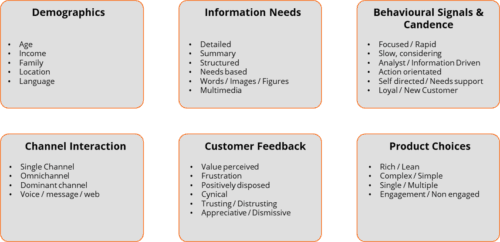
Example Customer Context
Our journey platform allows us to obtain and manage all this context and then to dynamically compile profiles and instructions for the LLM context window so that the AI Agent, using tools, can respond optimally.
A critical capability is that of tracking the result of the personalised engagement through definitively tracking if the customer reaches their goal. These analyses are then used to determine the effectiveness of the AI Agents in supporting achieving customer goals (which in turn we make sure is linked to customer revenue generation)
Way Forward for AI in Customer Experience in 2026
2025 has been an explosive year of development for AI and as mentioned at the onset of this newsletter, the news feeds have been trending with innovation after innovation.
The progress has not necessarily resulted in the kinds of ROI that is commensurate with the incredible investment in the space. The good news is that the investment has produced some amazing technology. As CX professionals we have an opportunity to apply those technologies to the CX space.
However, getting the benefits takes a little more effort and has more complexity that is often made out ie the notion of “An AI Agent will solve this problem” needs to be supported with very strong context management and that context comes from data that needs to be managed and orchestrated into the AI Agents to achieve the kind of results that are exciting.
Thank you for engaging the Customer Journey Insights Newsletter. All the best to those having a break over the festive season and I will be back in 2026 with more insights and musing about customer journey management
Regards
Trent
Connect with us
Find out how inQuba can help you transform your customer engagement strategy.
About inQuba Journey Management
Customer Journey Management is revolutionizing how businesses engage with their customers. Like a precision tool, it offers targeted, data-driven insights into specific customer cohorts, behaviors, and use cases, allowing you to act with accuracy and purpose. Unlike traditional CX approaches, which can sometimes yield flat results, our Journey Management solution combines Journey Analytics and Journey Orchestration to deliver a comprehensive view of your customers’ actual journeys.
With inQuba, you can visualize real customer journeys, understand the emotional drivers behind their actions, dynamically remove obstacles, and provide timely, personalized nudges to guide them toward desired outcomes. This strategic approach has proven to double customer conversion rates, transforming both customer experiences and business growth.
We’d love to learn more about your business challenges and discuss how inQuba Journey Management can empower your organization to achieve its goals. Reach out today to find out how we can assist you.