
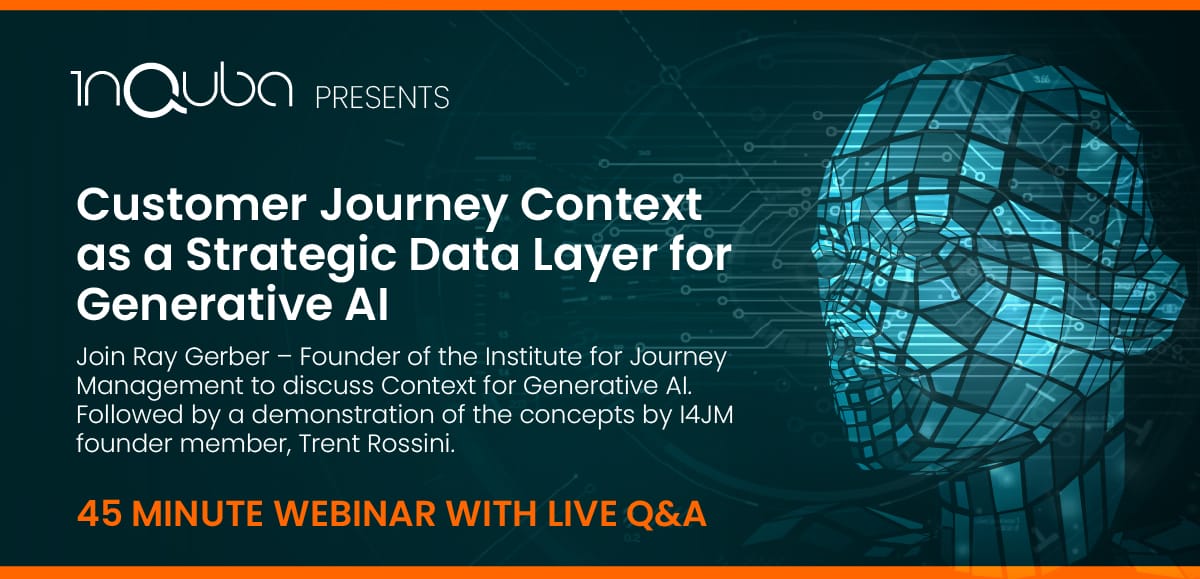
This Webinar will reveal why Context is the difference between Generative AI that sounds smart and Generative AI that actually moves the needle
Generative AI is everywhere and most of it is forgettable. Enterprise chatbots produce competent answers that no customer remembers. AI assistants generate polished responses that could apply to anyone. Personalisation engines that promised one-to-one engagement are delivering one-size-fits-all output at scale. The technology is impressive. The business impact is bland.
Leaders are wrestling with tough questions:
- Why does our AI feel generic when our customers are not?
- How do we move from “it works” to “it makes a difference”?
- What’s the gap between an AI that responds and an AI that actually helps a specific customer in a specific moment of their journey?
- Why does every AI investment seem to converge on the same uninspiring middle?
If you’ve ever felt that your Generative AI is technically functional but commercially unremarkable, this webinar is for you.
Webinar: Context for Generative AI : Why Journey Data is What Separates Effective AI from Everything Else
Featuring: Ray Gerber, Founder of the Institute for Journey Management (and former Chief Product Officer for Thunderhead of Thunderhead), in conversation on the principles of context engineering for Generative AI. Followed by a live demonstration from I4JM founding member Trent Rossini, CEO of inQuba, showing how journey context fed into AI Navigator that transforms Generative AI from generic to genuinely effective.
Date: 28 May 2026
Time: 14:00 UTC (16:00 SAST)
What You’ll Learn:
In this session, Ray and Trent will unpack the concept that quietly determines whether Generative AI delivers real value or just plausible output — and show it working in practice:
- Why the difference between effective and ineffective AI is rarely about the model :- it’s about the context the model is given
- How journey data, the structured record of where each customer has been, what they’ve done, and what outcome they’re working toward provides the richest, most differentiated context source for Generative AI
- The shift from AI that answers questions to AI that understands a specific customer’s situation, intent, and trajectory through their journey
- How real-time behavioural signals, journey state, drop-off points, and sentiment can be fed directly into Generative AI workflows
- Why retrieval, memory, and journey context are the three pillars of AI that customers actually find useful
- How Generative AI can hand a human agent the full journey context at the moment of escalation eliminating the “please explain again from the start” experience
- A live demonstration of inQuba’s AI Navigator in action : agents that know who the customer is, where they are in their journey, what they’ve already tried, where they’re getting stuck, and what outcome they’re working toward, orchestrating contextually relevant interactions in real time
Why You Should Attend:
- Because the AI conversation in your business is about to move from “which model” to “which context” — and you want to be the one leading that shift, not catching up to it
- Because the organisations winning with Generative AI in two years will not be the ones with the biggest models, but the ones with the richest journey data feeding them
- Because “personalisation” as a concept is being quietly redefined — and the new definition has very little to do with first-name tokens in an email
- Because the gap between AI demos and AI outcomes is closing for some companies and widening for others — and the difference is almost entirely about context
Then this is your opportunity to hear from one of the original architects of journey-based customer engagement, and to see, live, what becomes possible when Generative AI is grounded in the journey context it needs to be genuinely effective. This isn’t another AI hype session. It’s a fundamentally different way of thinking about why some AI implementations move the needle and others don’t with journey context at the centre, and Generative AI as the activation layer.